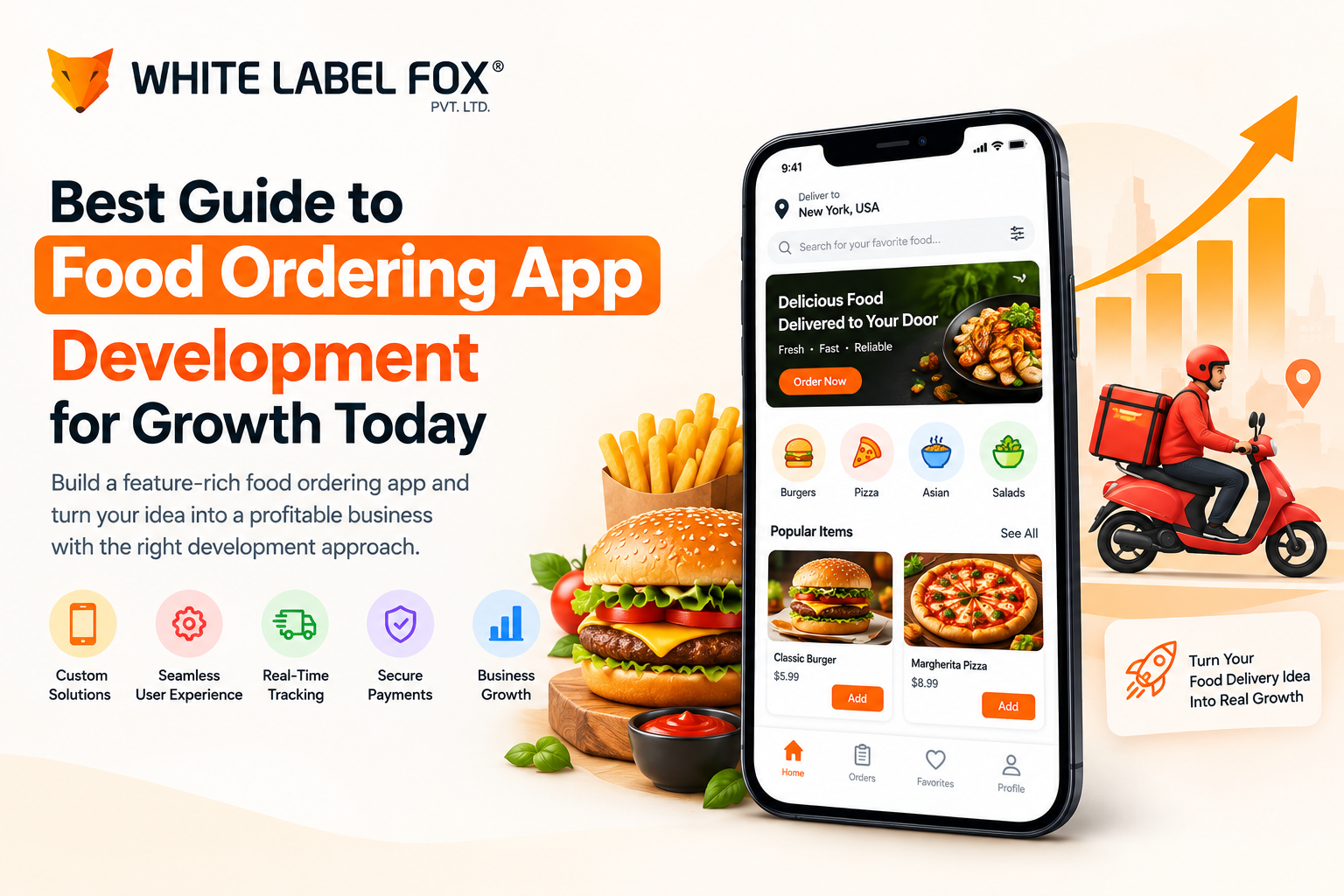
The food industry is becoming increasingly digital as customers look for convenient ways to discover restaurants, order meals, track deliveries, and make secure payments from their mobile devices. For startups, entrepreneurs, restaurants, and established businesses, launching a reliable digital ordering platform can create new opportunities to reach customers and expand into new markets.
A food ordering app development enables businesses to create customized platforms that connect customers, restaurants, delivery partners, and administrators in one digital ecosystem. A well-planned solution can support multiple restaurants, different delivery models, location-based services, order management, promotions, and real-time tracking.
However, launching a successful platform requires more than simply creating an ordering interface. Businesses need to understand their target market, define the right business model, select useful features, and provide a smooth experience for every participant.
What Is Food Ordering App Development?
Food Ordering App Development refers to the process of creating a digital platform through which customers can browse restaurants, explore menus, place orders, make payments, and monitor deliveries.
Depending on the business model, the platform can serve as a single-restaurant ordering application or a multi-vendor marketplace that brings numerous restaurants together.
A modern food ordering solution generally includes separate experiences for:
- Customers who search for restaurants and place orders
- Restaurant partners who manage menus and incoming orders
- Delivery partners who accept and complete deliveries
- Administrators who oversee users, restaurants, orders, promotions, and platform activities
This structure allows businesses to create a scalable ecosystem while providing convenience to all participants.

Why Businesses Are Investing in Food Delivery Platforms
Consumer expectations have changed significantly. Customers increasingly prefer digital ordering because it allows them to compare restaurants, check menus, receive order updates, and complete transactions without visiting a restaurant physically.
For entrepreneurs, this shift creates opportunities to develop specialized platforms for particular locations, cuisines, customer groups, or service models.
A business can also expand beyond traditional restaurant delivery by supporting grocery, pharmacy, convenience products, or other local delivery services. Multi-service platforms can use a similar digital infrastructure to connect different categories under one application.
For businesses entering this market, working with an experienced food delivery app development company can help transform a business concept into a structured digital platform while keeping the customer experience at the center.
Essential Features of a Modern Food Ordering Platform
A successful platform should focus on features that solve real customer and business needs. Adding too many unnecessary functions can make the user experience complicated, so businesses should prioritize features based on their target audience.
1. Restaurant Search and Discovery
Customers should be able to find restaurants quickly using search, categories, cuisine types, location, ratings, and other relevant filters.
A well-organized discovery experience can help customers explore available options without spending unnecessary time searching through multiple screens.
2. Digital Menu Management
Restaurants should be able to showcase their dishes with relevant descriptions, images, variations, availability information, and other details.
A clear digital menu gives customers the information they need before adding products to their cart.
3. Simple Order Placement
The ordering process should be straightforward from restaurant selection to checkout. Customers should be able to add items, modify selections where applicable, review their orders, and confirm delivery details easily.
Platforms inspired by popular solutions such as an UberEats clone script can demonstrate how restaurant discovery, ordering, delivery tracking, and customer interactions can be organized within a unified experience.
4. Real-Time Order Tracking
Customers want visibility after placing an order. Real-time tracking can show important order updates and provide greater transparency throughout the delivery process.
Delivery partners can also use status updates to keep restaurants and customers informed about order progress.
5. Multiple Payment Options
Payment preferences differ across markets. Businesses targeting international customers should consider payment methods that are commonly used in their selected regions.
Providing suitable payment choices can reduce friction during checkout and make the overall ordering experience more convenient.
6. Restaurant Management
Restaurant partners need tools to manage menus, accept or reject orders, update availability, monitor order statuses, and manage important information.
A well-designed restaurant management system can help partners handle daily operations more efficiently.
7. Delivery Management
Delivery partners play an important role in the customer experience. The platform should help them receive delivery assignments, view pickup and drop-off information, update order status, and complete deliveries efficiently.
8. Ratings and Reviews
Customer feedback can provide useful information about restaurant quality and delivery experiences. Ratings and reviews can also help new customers make informed choices.
9. Notifications
Timely notifications can keep users updated about order confirmation, preparation, pickup, delivery progress, and completion.
Popular Food Delivery Models Businesses Can Explore
There is no single model that works for every business. Entrepreneurs should select an approach based on their market, target customers, restaurant relationships, and operational strategy.
Multi-Restaurant Marketplace
A multi-restaurant marketplace allows customers to browse and order from different restaurants through one platform. This model can help businesses build a larger restaurant ecosystem within a particular service area.
The FoodPanda clone concept, for example, can be studied as a reference for understanding how a multi-restaurant marketplace can bring customers and restaurant partners together.
Restaurant-Owned Ordering Platform
A restaurant group or food business may prefer a dedicated platform that allows customers to order directly. This approach can give the business greater control over its digital ordering experience and customer interactions.
On-Demand Delivery Platform
An on-demand model connects customers, restaurants, and delivery partners through a centralized platform. Orders can be coordinated while delivery partners handle pickup and delivery activities.
The Doordash Clone App model can provide businesses with ideas for organizing restaurant discovery, delivery coordination, and customer ordering within an on-demand ecosystem.
How to Start Building a Food Ordering Platform
1. Define Your Target Market
Before starting development, identify the location and customer group you want to serve.
Consider factors such as:
- Restaurant availability
- Customer ordering habits
- Popular cuisines
- Delivery expectations
- Payment preferences
- Local competition
- Service coverage
A clear understanding of the target market helps businesses build a platform around actual customer requirements.
2. Choose the Business Model
Decide whether the platform will focus on a single restaurant, multiple restaurants, direct ordering, or on-demand delivery.
The business model should determine which features and workflows are essential for the first version of the platform.
3. Study Existing Platforms
Researching established food delivery platforms can provide useful insights into customer journeys, restaurant onboarding, delivery processes, promotions, and user engagement.
For instance, examining a Zomato clone can help entrepreneurs understand how restaurant discovery, reviews, menus, and ordering can be brought together in one platform.
However, businesses should avoid simply copying an existing application. Instead, they should identify gaps in their target market and develop features that address specific customer needs.
4. Plan the User Experience
Map the complete customer journey, beginning with restaurant discovery and ending with order delivery.
The same approach should be applied to restaurant and delivery partner workflows. Every user should be able to complete important actions without unnecessary complexity.
5. Select a Suitable Development Approach
Businesses can choose between building a platform from scratch or customizing an existing solution.
A ready-made approach can help businesses begin with established functionality and adapt the platform to their specific requirements. Customization can include branding, workflows, service categories, user roles, and market-specific requirements.
6. Test Important Workflows
Testing should cover the complete ordering journey. Businesses should verify restaurant discovery, menu browsing, cart management, order placement, payments, notifications, delivery updates, and order completion.
Testing different user scenarios before launch can help identify usability problems and improve reliability.
How to Create a Better Customer Experience
Customer experience can strongly influence whether users return to a food ordering platform.
Make Restaurant Discovery Easy
Customers should quickly find relevant restaurants based on their location, preferences, cuisine, and availability.
Simplify Ordering
A shorter and clearer ordering process can make the platform easier to use. Customers should not have to navigate unnecessary screens before confirming an order.
Provide Clear Order Updates
Customers appreciate knowing what is happening with their orders. Clear status information can make the delivery process more transparent.
Support Restaurant Partners
Restaurants are an important part of the marketplace. Providing practical tools for menu management, order handling, promotions, and performance monitoring can encourage stronger partnerships.
Personalize the Experience
Businesses can use customer activity responsibly to provide relevant restaurant suggestions, categories, and promotions. Personalization should add convenience rather than make the application feel complicated.
Opportunities for Business Expansion
Food delivery does not have to remain limited to restaurant orders. Businesses can gradually explore additional local services when there is sufficient demand.
A platform can potentially expand into grocery delivery, local shopping, household services, or other on-demand categories.
The Zomato clone script model can also be examined by entrepreneurs interested in understanding how restaurant discovery, food ordering, and related digital services can be organized into a broader ecosystem.
Similarly, the JustEat Clone approach can provide ideas for businesses studying marketplace-based restaurant ordering and customer engagement.
The important point is to expand according to customer demand rather than adding unrelated services simply to increase the number of features.
Working With a Food Delivery Development Partner
Selecting the right food delivery app development company is an important step for businesses planning to launch a digital ordering platform.
An experienced development partner can help with requirement planning, platform customization, feature selection, user experience, third-party integrations, testing, and launch preparation.
Businesses should evaluate potential partners based on their experience with marketplace applications, customization capabilities, technology expertise, portfolio, support process, and understanding of on-demand business models.
For startups and entrepreneurs, working with an experienced partner can also make it easier to turn an initial business concept into a structured and launch-ready platform.
Conclusion
Food Ordering App Development provides startups, entrepreneurs, restaurants, and established businesses with an opportunity to create convenient digital ordering experiences for modern customers.
A successful platform requires more than basic ordering functionality. Businesses need a clear target market, suitable business model, practical features, simple user journeys, reliable restaurant partnerships, and continuous improvements based on customer feedback.
Businesses can begin with a focused food delivery concept and gradually expand into additional services as their marketplace develops. Partnering with an experienced clone app development company can help entrepreneurs customize a proven foundation around their business objectives and target market.
With a customer-focused strategy and the right digital approach, a food ordering platform can become a strong foundation for building a scalable presence in the global on-demand economy.
Frequently Asked Questions
1. What is Food Ordering App Development?
Food Ordering App Development involves creating a digital platform where customers can discover restaurants, browse menus, place orders, make payments, and track deliveries. The platform can also connect restaurants, delivery partners, and administrators.
2. What features are important in a food ordering app?
Important features can include restaurant discovery, menu management, search and filters, cart management, order placement, payment options, order tracking, notifications, ratings and reviews, restaurant management, and delivery management.
3. Can startups launch a multi-restaurant food delivery platform?
Yes. Startups can create a marketplace that connects customers with multiple restaurants and delivery partners. The platform can be customized according to the target market, service area, and business requirements.
4. Can a food ordering platform expand into other services?
Yes. Businesses can potentially expand into grocery delivery, local shopping, household services, and other on-demand categories. Expansion should be based on customer demand and the business’s operational capabilities.
5. How can businesses improve their food ordering platform?
Businesses can focus on simple navigation, fast restaurant discovery, convenient ordering, transparent delivery updates, useful restaurant management tools, personalized experiences, customer feedback, and continuous platform improvements.